Rukhaiyar's Corner

  • Home
  • About
  • Blog
  • General
    • Education
    • Society
    • Economy
    • Politics
    • Defence
    • History
    • IT Sector
  • Internet
    • SEO
    • Domain
    • Hosting
    • Apps
  • Privacy Policy
  • Contact Us
  • Home
  • Contact Us

Corruption is The Price We Pay For Democracy

November 11, 2012 by Abhishek Rukhaiyar Leave a Comment

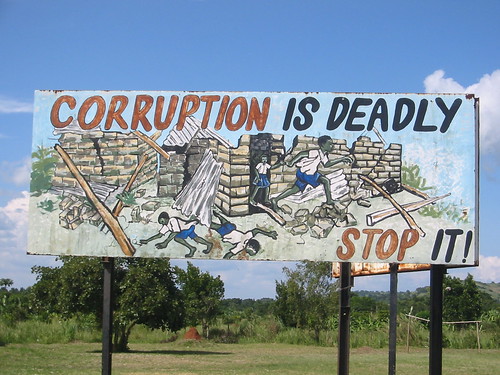
Corruption is Deadly

Corruption is Deadly,

“Corruption is the price we pay for democracy“. This statement connotes that with the good governance form, democracy. We also have to abide its companion, corruption, which comes along with it. This is the fee we pay for the good governance, democracy.

Let’s talk about corruption. Corruption is the abuse of power. The person with the power when uses his influence for benefit of himself or some special person it is called corruption. The most common cause of corruption is believed to be a combination of discretion and accountability. Governments with enormous discretionary power and low accountability are more corrupt than those with less discretion and more accountability.

Mainly, there are three forms of government. Other than democracy, the two others are Monarchy and Autocracy. In Monarchy, ruling people is always from a single family. This is the most common and used form of government for thousands of years. The head of government is called king which has ultimate power. No one can ask question to him about his deeds. As in this system, discretionary power is totally in the hands of one man with no accountability. This is proved to be very corrupt governance. That’s why democracy had replaced earlier popular Monarchy.

Monarchy is not very much popular now a day. Only five countries still have absolute monarchy. Rests have changed itself into constitutional monarchy, a kind of democracy, to reduce corruption in its system. These new monarchs are more clean and accountable than absolute monarchy. So, this monarchy is less corrupt.

In Autocracy, the country is governed by a dictator or military junta. This system is almost same as monarchy. But, some major difference is no clan system and usually citizens are against the rulers. So, there is no backing from the citizens. The accountability of bureaucrats is negligible in this system. Bureaucrats use their power mostly for personal gains. It is the worst case for corruption. Most autocracies are among top corrupt nations in the world.

Now, talk about democracy. Democracy is a very popular form of government. Originally, democracy is the rule by the people. But, currently, no country is governed by this form of governance. However, almost 70-80 % of all the countries follow the improved version of democracy, i.e. Republic. Republic is the rule by the law or a constitution. May be very few of you know that officially India is not a democratic nation. But, a republic and its official name is not “India”, but “Republic of India”. In this form of government, no one is supreme. Everyone is accountable. Of course, corruption exists in democracies as well, but such corruption, trivial in both nature and sum, is fundamentally different from the massive looting by autocrats or monarchs.

In Transparency International’s Corruption Perception Index 2008, which covered 180 countries, 90% of the 60 least corrupt countries in the world are democracies. The remaining six non-democracies are small city-states (Singapore, Hong Kong, United Arab Emirates, Oman, Qatar and Bahrain). In contrast, about 60% of the 60 most corrupt countries are autocracies, including Russia, Iran, Venezuela, Belarus, Syria, Sudan and Burma. Nearly all the 30 most corrupt countries are autocracies. India in this list is at 84th position.

These data show it very clearly that corruption is in every popular form of government. Particularly, the other forms of government are much ahead in the corruption index than democracy. So, ‘Corruption is not the price we are paying for democracy’.

Filed Under: Economy, Politics Tagged With: autocracy, corruption, democracy, government, monarchy

Is Sonia Gandhi Eligible To Become The Prime Minister?

May 17, 2010 by Abhishek Rukhaiyar Leave a Comment

SG

Can She Be An Indian PM

As the election campaign is drawing to its close (April-May 2004) the issue of Sonia Gandhi being suitable or not for Prime Minister-ship due to her being a foreigner are coming out once again. Here one is not talking of her suitability for holding the top place in Indian administration but is restricting to the point whether Indian Citizens, whose place of birth does not happen to be in India are eligible for such a post or not? Needless to say
this issue is being raked up since Sonia Gandhi first joined the Congress and has been contender for the top job in the country. Needless to say this also reflects the bankruptcy of the electoral campaign in a country, which is riddled with infinite problems for the poor masses irrespective of its being shining for a minuscule section of the society. It also hides the fact that those raising it can twist the logic the other way around when it suits their own electoral needs.

The latest argument being put forward is that giving the sensitive posts to such people may be a security risk. In between the same argument has been extended to other posts apart from the one of Prime minister. In between the argument was also put forward that the children of such citizens also are not eligible for the top jobs. For those raising this issue, it is not much of their concern about what does constitution says on this. It is not of much concern here that people have accepted whole-heartedly, such people through the electoral system. Lately, Amma (Jayalalitha) has come forward to ask that is there not a single Indian capable for such a post, that we have to look at a foreigner to lead the country? It must be pointed out that two words are used interchangeably here, the word foreigner and the word person of foreign origin.

Talking of Sonia Gandhi, she has been the main target of such snipers. Initially it was also said that the work of conversion being carried on is also drawing support from her. Her connections with Italy are ridiculed by posing the alternative between Ram Rajya and Rome Rajya. The mudslinging has no end and bucket full of muck can be smeared on this issue. How does a country decide this point in a globalised world?

One recalls that there is a great joy and celebration when we hear about the person of Indian origin holding top jobs in other countries. There are small countries where the people of Indian origin have held the top job. Bobby Jindal’s surge for the medium level job was a matter of three or four cheers in Indian media and psyche. While talking about the people who were born in other parts of the world but adopted this country for their major commitment one recalls the likes of Maulana Abul Kalam Azad, Annie Beasant and Mother Teresa to be the shining examples in this category. Even the worst of communist would not have objected to Maulana Azad holding the post of Indian National Congress or than becoming the education minister just because he was not born in this part of the land.

Where does one draw the cut off date? A person of Indian origin in the proper sense of the word is the current dictator of Pakistan, and had been the most hated name just prior to the cricket series. Currently, a person of Pakistani origin happens to hold the post of Deputy Prime minister in India.

Today there are some countries where their constitution says that only person who has been born in that country can be Prime minister or President. There are also countries where such a norm does not prevail. Our constitution does not hold any prescription about he place of birth of the citizen. Citizenship is the criterion for holding the top posts. To begin with those saying that being born in this land is a must, are saying something, which violates the Indian constitution. Any way the people of Sangh combine, who began it all, have no respect for this constitution, as this constitution has emerged from the freedom struggle, due to India becoming a modern nation-state through the anti-British struggle, with which they had nothing whatsoever to do. They are itching with all their might to do away with this and are waiting in the wings to do so. None other than RSS supremo K.Sudarshan went on to say the same.

Other politicos, like Sharad Pawar and Amma, those who have picked up the cue initially thrown in the circuit by RSS progeny, are doing so in a purely opportunistic way. Sharad Pawar who broke away from the Congress on this ground did come back to ally with the same party for electoral reasons. Amma and others again are playing the role of holier than thou, lacking other political issues they are trying to make an issue out of it. It can whip up emotions of the society, that’s for sure. This politics like the one of Ram temple movement is a sort of one based on emotional pitch.

Is being a citizen not good enough for holding any post of the people find you fit enough for that? The transnational movement of people across the countries is on the rise. Many of those of Indian origin are active in the politics in other countries. Sonia Gandhi or no Sonia Gandhi, the guidance should be derived from the constitution. We have multitude of examples of Islāmic countries, where fundamentalism prevails, where the concept of citizenship is modulated according to the whims of the ruling coterie. Taliban in Afghanistan during their brief tenure did dictate about how people of different religions should wear and behave.

In our own country books of Golwalkar and Savarkar have given the guidelines about the status and ranking of citizenship according to their religion. Savarkar defines the citizen on the ground of one’s Holy land and Father land. Golwalkar calls Christians and Muslims as Foreign races. If we keep going back in time the results will be disastrous. Mahatma Jotiba Phule calls the Aryans as the invaders, and thereby foreigners. In Sri Lanka, the dominant Buddhists called themselves as the first comers and so having a bigger ownership of the country. Golwalkar also says that the country is of the Hindu race, and the Muslims and Christians, who as they are foreigners, should have no citizenship rights. When this was being written large section of Muslims and Christians were participating in the process of building of India as a nation-state through the struggle for freedom, along with the Hindus and people of all the religions of the country.

Where will the logic of all this takes us is any body’s guess. The politics should work within the constitutional limits, it should be purged of the emotive content so that the real issues of the people are to the fore and there by headway can be made for a more egalitarian society, a society where the concept of human rights is the final arbiter of social and political norms.

Filed Under: Politics Tagged With: Gandhi, india, Prime Minister, Sonia Gandhi

Reservation in Parliament for Women

April 12, 2010 by Abhishek Rukhaiyar Leave a Comment

Women in India are mostly considered as only housewives, one who looks good at home but not very much welcomed as a professional. Women in present time is coming out of home and working along with the men. Still very few women are in the working arena. Most of the jobs need mental effort along with a bit of physical contribution. There are jobs which require physical effort for the work. Like the job of labor class. There is more equality between men and women in these professions than in those which require less physical work. The reason may be that many feels that women are not fit to take tough decisions.

In India, the number of women politicians is very less. It’s true that most of the women leaders are at the top. But, this is not helping the situation of women. Women are not getting help from these very few leaders, who are bound to take decisions which favor men more. Other than that, the most important decision for the welfare of our country is taken ignoring the will of half of the society, i.e. women.

Government is trying to improve the quality of women by giving them more power by ensuring 33 % seat in the parliament and state assembly to them. It looks as 33 % is very less compared to original ratio of male female 1:1. But, for now this much amount is very high compared to current situation. Currently, on an average 5- 10 % seats are with women in center or state assemblies. The participation of more women in political system will result in more support for women. Also, it is believed that new woman leaders will work more for the welfare of other women. Also, female leaders concern more for their job, duty and responsibility than male. The involvement of women in work will be improved in much better way than now. Also, the situation where women honor is taken lightly by the administration and rapist are given protection from punishment by the politicians and bureaucrats. These cases will be reduced by involvement of more women at the top.

The women reservation bill was rejected in the parliament for many times. Almost fourteen years back, in 1996 the bill was first introduced by the Deve Gowda’s Government. But, soon after, the government became in minority and the Lok Sabha dissolved. Later, every government tries to pass this bill. But, as parties in power are themselves not very much united on the bill, it lost its front every time. In Feb 2010, two major parties, INC and BJP, came in support of this bill. The bill was introduced in the Rajya Sabha. This time after a lot of drama, the bill was historically passed in the upper house. But, it has still a long way to go. It is to clear Lok Sabha and lastly to be signed by the President.

The main feature of the bill is that the bill is to be implemented for 15 years. After then, it will be reviewed for amendments. In each term, one third of the constituencies will be allotted for women only. Others are open for all. So, at least 33 % seats will be taken by women. However, the percentage of women could increase from 33 %, if they win from any other non-reserved seats. Also, each seat will be under the reserved category in one out of three elections.

The bill is taken in accordance to the outcome of 1994 amendment for Panchayat level election, where the same pattern was implemented. Initially, the seats were taken mostly by proxies of men leaders. But, later on women started knowing their power and the proxies are reducing. Women are working in better way than men. They are focusing more on the basic problems of their village than male candidate. The proof is increase in participation of women. The data shows in some states women participation has increased to more than 40 %. No doubt, the experiment has showed impact of women’s bill.

The leaders who are in opposition of this bill ask for the reservation of backward caste and tribes in the reservation bill. They say that this bill will only avail women from upper caste and good economic condition. Some also argue that this bill will result in less qualified women being elected. Some suggest that the reservation should be at ticket distribution level of party. Others also, fear the dominance of female in the society will be fatal for culture or for male dominance. Some fear the end of their career by this bill, as it may be their seat being reserved in the next term. Some party is arguing for more debate on the bill.

All these are in one way or another are reasons to put the bill on delay. Those who are in opposition are mostly traditional, backward beliefs party leaders. Like Lalu Yadav, Mulayam Singh Yadav and Sharad Yadav. In some way or other they delayed the bill for past 14 years and want it to be in queue for following years too.

Filed Under: Politics, Society Tagged With: india, parliament, reservation, Women

Recent Posts

  • Easy WordPress-NGINX Configuration – EasyEngine
  • Examination – Has It Killed Education?
  • Organic Foods: Are They Worth The Hype
  • Introduction From Basic: What is WordPress?
  • How Good Are The New IITs

Recent Comments

  • Abhishek Rukhaiyar on JEE: Should I Take A Drop?
  • kiara on JEE: Should I Take A Drop?
  • nobin on When Should I Start Preparing for IIT?
  • nobin on When Should I Start Preparing for IIT?
  • Abhishek Rukhaiyar on IIT JEE: What should be the strategy for repeaters?

Design

With an emphasis on typography, white space, and mobile-optimized design, your website will look absolutely breathtaking.

Learn more about design.

Copyright © 2026 · Sixteen Nine Pro Theme on Genesis Framework · WordPress · Log in