Rukhaiyar's Corner

  • Home
  • About
  • Blog
  • General
    • Education
    • Society
    • Economy
    • Politics
    • Defence
    • History
    • IT Sector
  • Internet
    • SEO
    • Domain
    • Hosting
    • Apps
  • Privacy Policy
  • Contact Us
  • Home
  • Contact Us

Top 5 Budgeting Apps for iPhone

December 8, 2012 by Abhishek Rukhaiyar Leave a Comment

In this high-tech generation most of the people are concerned about their lifestyles. People are making every possible way to save money. The technology is making some fabulous innovations which can track your expenses and make you think beyond your expenses.

In the market there is lots of boom with the launch of Smartphones like Samsung S3 and the iPhone which has amazing apps which are helpful to you in your daily by many ways. These apps belong to different categories like business, finance, entertainment, gaming, sports and many more. Business, finance and gaming are most downloaded categories as these help in your work and leisure time. There are lots of finance and budgeting applications which are helpful to track your expenses and finance matters. Some of them are;

Expenditure:

Expenditure

Expenditure: A very nice expense tracker

This is the amazing application which tracks both finance and budget. It has superb features to make your work efficient and display the accurate results by making the transactions. This app comes with all types of the budgeting process with different categories like household budget, electronics, food and many more. When you do any transaction it will give you the accurate report. It also has the inbuilt currency converter to make your transactions go easy.

Visit iTunes App Store for Expenditure

Smart Budget:

Smart Budget : With smart interface

Smart Budget : With smart interface

This application lets you to control your expense in a smart way. It gives you the details of each and every penny spends. It shows you the details in different categories. It calculates your income, salary, incentives and the expenditures like food, clothing, accommodation, travel, hotel etc… This app keeps the track of things how much they are used and things which are never used. It shows you the results in daily, weekly or on a monthly basis. It produces the report in the form of sheets and graphs. It is a simple budgeting to use.

Visit iTunes App Store for Smart Budget

Spendings:
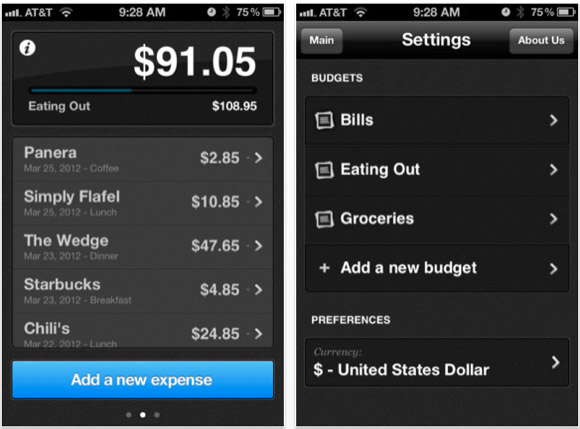
Spendings: A lightweight App

Spendings: A lightweight App

This is also the amazing application which shows you the report on a weekly budget. It is as simple as opening an account and maintaining it. It tracks all the money you got and the money you spend. It provides you the detailed information about the Spendings on the purchased items. It also has the option of currency converter from dollars to pounds which makes you easy to understand and handle the budget. You can set and manage 10 various budgets at one time.

Visit iTunes App Store for Spendings

Payday Loan Calculator:

Payday Loan Calculator: Instant Cash

Payday Loan Calculator: Instant Cash

This is a free application for the iPhone as well as Android users. This Payday loan calculator instantly calculates all your loan premiums. All you need to do is to enter the amount and the term of the deposit with the interest fee of payday loans then this calculator will evaluate your amount display you the accurate results. It will calculate your total amounts and can also track your loan premiums which you have to pay. Calculate repayment instantly. Apply for a payday loan anywhere in the UK.

Visit iTunes App Store for Payday Loan Calculator

Pageonce:

Pageonce: Money & Bills

Pageonce: Money & Bills

This is also the superb application which not tracks your budget but also tracks your bills. You can also pay your bills and loans with the help of Pageonce. You will get the detailed report of what has been paid and what is due. For this you can also set reminders. This app is smarter than the other finance apps as it is simple and can be understandable. It also tracks your daily, weekly and monthly expenses and send you the reports with details of expenses.

Visit iTunes App Store for Pageonce

Filed Under: Apps Tagged With: App Store, Budget, Expense, finance, full-image, iPhone, Payday loan

Impact of IT/ITES on Indian Economy

January 13, 2011 by Abhishek Rukhaiyar 3 Comments

Imagine two persons talking about the growth rate of India! Can they discuss it without the role of Information Technology (IT) and Information Technology Enabled Services (ITES) in Indian Economy? Now, think about another situation. Two persons are talking about the growth rate of India and the year is 1985. So, what do you think, would they be talking about the role of IT/ITES in Indian Economy? I don’t think so. Twenty five years back, no one would have dreamt of India as a major IT exporter. The nation lacking food & money would be a big player in computer sector. Today, it is one of the fastest growing nations and IT/ITES sector is busy writing the success story of India.

IT/ITES

Today, India’s GDP is growing at a massive rate of 8.9% (estimated FY2010-11). It is expected that the share of IT/ITES industry in this GDP will be 6.1% as against 1.2% of 1998. For the past 10 years, GDP of India has grown on an average 6-7% every year. If a sector’s share in this growing GDP has increased from 1.2% to 6.1%, what could be the growth rate of that sector? Revenue of IT/ITES of India for FY2010 is expected to be 71.3 billion USD compared to merely around 6 billion USD in 2000. The growth in number of employees here for the past ten years has been 26%, making it largest employer in the organized private sector. Currently, direct employment by this sector is 2.3 million. Out of total Indian exports, 26% is the share of this sector for FY2010 as compared to 4 % in 1998. These are some figures which tell the story of storming by IT/ITES industry for the past ten years.

Indian economy has gained a lot from the development of IT/ITES sector. Research shows that out of every 1 job created in this sector, indirectly 4 additional jobs were created, 75% is for those who are SSC/HSC or less qualified, 15.85bn spent by this sector in the domestic economy in the FY2006, generated an additional output of 15.5 billion.

The development of this sector has not limited itself to Tier-I cities like Bengaluru, Chennai, Hyderabad or NCR. It is going deep into Tier-II or III cities. An example is Bhubaneswar, a Tier-III city where all 4 major Indian IT companies: Infosys, Satyam, TCS and Wipro are present. In 2006-07, Orissa’s exports has raised by 60% over 2005-06. To promote this sector, SEZs are being built around with improvement in roads, retail, entertainment and housing facilities. The ratio of employees – technical to non-technical is 80:20, 4% come from economically backward class, while 58% of total employment is from Tier-II/III cities, and 30 % are in the age group of 18-25 yrs. These data show how this sector is penetrating the national economy and enhancing it right from the root.

India was known for exporting low technology oriented products of low quality. Now, to compete in the global market, IT/ITES companies have adopted high quality standards. This in turn affects other sectors too. In the process, not just India’s IT product is becoming a quality brand. But, overall ‘Made in India’ is getting quality brand recognition. Listing of Indian IT/ITES companies in various global stock exchanges, which requires abiding by strict global accounting norms, has helped build a strong image of companies and sector outside India. Indian IT/ITES industry is taking a key role in different acquisitions and mergers of overseas companies. This sector had highest share, 23% in outbound M&A deals in FY2006.

Till the advent of IT/ITES industry, Indian corporate consisted of only 2 types of companies-either large family owned business or multi-national companies. First generation entrepreneurs were hard to find. Now, the funds are enormous to support them. Their success has given confidence to other middle class individuals to exploit their chance of success. In the process many new first generation billionaires have come up. Some IT/ITES companies adopted the practice of Employees Stock Option Plan (ESOP), which enabled them to share their wealth with the employees to get more effort-based efficient work. Later, other companies too adopted this practice. Thereby, this process created many salaried employees.

ROLE OF IT/ITES

Direct contributions:

•    Growing share of the country’s GDP.

•    Boosting the foreign exchange reserve of India.

•    Employment generation.

Indirect contributions:

•    Additional employment generation.

•    Driving growth of other sectors of the economy.

•    Encouraging balanced regional development.

•    Fuelling the growth of PE/VC funding.

•    Improving the product/service quality level.

•    Spurring 1st generation entrepreneurship.

•    Front runner in practicing good corporate governance.

•    Boosting the image of India in the global market.

Diversity in employment

•    Encouraging employment of differently-abled: 60% of the employees.

•    Opening opportunities for non-technical personnel.

•    Creating employment opportunities in smaller towns/cities: 33% to 50% employees.

•    Promoting women: over 30% and youth employment.

•    Creating opportunities for the ‘out-of-the-main-stream’ candidates.

Initiatives for HRD:

•    Training of workforce through collaboration with educational institutes.

•    Promoting higher education through scholarships and tie-ups with educational institutes.

•    Improving work environment by providing recreational facilities and work-life balance.

Socially relevant products and services:

•    Education

•    Employability and entrepreneurship

•    Health

•    Bridging the digital divide

Conclusion

The IT/ITES industry has made a beginning and with the encouragement and support of NASSCOM and NASSCOM Foundation, it is on track to set an example that would encourage others to emulate and help changing the face of India. It is apt to conclude with a remark made by Nobel Laureate Dr. Amartya Sen, about the Indian IT/ITES industry, during his key note address at the NASSCOM India Leadership Summit 2007 –

My point is not that the IT industry should do something for the country at large, for that it does anyway. It makes enormous contributions; it generates significant incomes for many Indians; it has encouraged attention to technical excellence as a general requirement across the board; it has established exacting standards of economic success in the country; it has encouraged many bright students to go technical rather than merely contemplative; and it has inspired Indian industrialists to face the world economy as a potentially big participant, not a tiny little bit-player. My point rather, is that it can do even more, indeed in some ways, much more. This is partly because the reach of information is so wide and all-inclusive, but also because the prosperity and commanding stature of the IT leaders and activists give them voice, power and ability to help the direction of Indian economic and social development.

Filed Under: Economy, IT Sector Tagged With: economy, finance, IT, ITES

Should FDI be Allowed in Higher Education

January 7, 2011 by Abhishek Rukhaiyar 2 Comments


The ‘India Vision 2020’ envisages the transformation of India into a knowledge superpower. To achieve this vision, the higher education sector has to play a key role. At present India is producing highest number of doctors and engineers every year. But, if one considers the quality and quantity of higher education in India. It is worse. In US and UK, percentage of enrolment in higher education is 82.4 and 60.1 respectively. In India, despite recent increment due to private players, current enrolment is merely 12 %. Even South East Asian countries have higher enrolment rate like 31% in Philippines, 27% in Malaysia, 19% in Thailand and 13% in China. According to United Nations Educational, Scientific and Cultural Organisation (UNESCO), public spending on higher education in India is merely US $400 per students. If we consider public spending of US on higher education, it is $9629. It may be argued that the spending of India could not be compared with that of US. However, even other developing nations like Brazil, China or Russia have much higher public expenditure per student, in excess of $1000.

India’s higher education system is the third largest in the world, after China and the United States. The main governing body at the tertiary level is the University Grants Commission (India), which enforces its standards, advises the government, and helps coordinate between the centre and the state. As of 2009, India has 20 central universities, 215 state universities, 100 deemed universities, 5 institutions established and functioning under the State Act, and 13 institutes which are of national importance. Most of these institutions are public funded. Some of these institutions have been globally acclaimed. However, India has failed to produce world class universities like Harvard, Stanford, Oxford, Cambridge or MIT.

The state of higher education is very bad in India. The education system in India is often criticised for being Rote Learning, rather than problem solving. The status of teaching in most of the public run colleges in India is ill. If we see the situation of colleges in metros and cities, it may come under average level. But, the situation of colleges in small cities is very bad. The main aim for the students here is to get certificate. Corruption and negligence could be easily found in the examination conducted by these colleges. Some private universities have started operations in India. But, most of them are not giving the quality, they are for money making. In the recent years, many of the new private institutions have opened in India. But, most of them are for engineering and B-schools. The scenario is this that India is producing almost 750,000 engineers and 100,000 MBA graduates every year. But, if we see the skill in this army of graduates only 20-30% of them are doing the particular course due to interest or skill. Rest of them are there just because it is going to give them good jobs.

India in the process of becoming a developed nation needs to be technologically independent. Right now, India is dependent on other nations for technology. We are not spending a lot on Research and Development. In fact, if we see the track record in many sectors we are dependent on technology imports. Like India is the largest importer in the world for defence equipment. For the current 3G mobile technology, India is looking towards China and US for imports of machinery. India needs to spend a lot on research work. But, the atmosphere here is not research oriented. Even, in IITs, many professors find it hard to get funds sanctioned for researches.

Every year nearly 0.4 million Indians go abroad for higher studies spending approximately $ 12bn. This leads to not only loss of foreign exchange, but also ‘Brain Drain’, as most of these rarely comes back to India after completing their courses. The primary reason for a large number of students seeking professional education abroad is lack of capacity in Indian Institution. There is no doubt that the situation in public universities in India is not so good. Also, with increasing enrollment in higher education, it is not possible for the government to provide higher education on its own. But, the private institutions are themselves sick. Many don’t have experience and many are trying to just gain money without quality. Foreign investment in this field will not only check brain drain, it will also help to balance the demand supply ratio. It will develop competitiveness among private universities to deliver better quality. It will also generate employment and result in inflow of money instead of outflow. Further, the infrastructure will improve. There will be better scope for research as foreign university have different methodology to run and generate revenues. They are more research based universities. Plus India may move towards practical study based learning rather than rote learning. Other than that, India could develop itself as a provider of higher education for developing nations.

At present India is allowing 100% FDI in higher education through automatic sector. But, still no university have established a campus here, due to a large no. of guidelines and regulation. Also, many rules are unclear. Indian government is trying to pass a bill, The Foreign Educational Institutions Bill, in the parliament to directly allow 100% FDI in higher education. Right now 106 institutions are running programmes in India with collaboration with foreign universities. But, only 2 out of 106 are approved by AICTE. Indian government does not allow foreign universities to award any separate degree. It could only provide dual degree with collaboration with local institutions. Currently, many degrees given by these foreign universities are not even recognized in their own countries. Most of the universities which have tie ups with local institutions are small private universities in their own countries. If The Foreign Educational Institutional Bill will be passed, it will not only allow foreign universities to set-up campuses and award degrees in India, but simultaneous facilitate Indian government regulation of their operations.

The purpose of the bill is to regulate entry, operation and quality of education by the foreign universities. The bill will allow them to earn the status of Deemed University, which in turn will make them come under the domain of University grant commission (UGC). The foreign university then have to invest at least 51% of the total expenditure for such establishments. There will be large amount of money allocated only for the development of higher education. Plus scientific research will not be in the stage of shortage of money.

Features of the Foreign Educational Institutions Bill:

  • No foreign institution can provide degree to Indian student unless such institution is confirmed as Foreign Educational Provider by Indian Government
  • At least twenty years of establishment in its own country
  • Have to maintain a fund of at least 500 million rupees
  • Quality of education, curriculum, method of imparting and the faculty employed will be in accordance to guidelines of UGC
  • At max 70% of the income raised from the fund can be utilized in the development of institution in India and rest should be added to the fund. No part could be used in any other purpose other than growth and development of the institution established by it in India
  • Institution has to publish prospectus writing clearly about fee structure, refund norms and amount, number of seats, condition of eligibility with min and max age, detail of faculty, process of admission, min pay payable to each category of teachers and staff, infrastructure and other facilities, syllabus, rules and regulations, etc. at least sixty day prior to date of commencement of admission
  • In case of violation of any guidelines a penalty of min 10 million and max 50 million rupees along with tuition fees should be refunded to the student
  • Any foreign institution not confirmed by Indian government as Foreign Education Provider which is awarding any certificate to Indian students should submit a report regarding course to the commission

The academics, educationists and politicians are sharply divided on whether this will be a good move for India or not. As till now the experience with the foreign universities is not so good. Foreign investors in higher education have so far brought just commercial products, and may be in the future too, will bring copyrighted courses and workshops modules in order to make money. There courses will be less in accordance with the need of the Indian students or requirements of Indian science and research. Also, questions are raised about the Intellectual Property Rights, who will own the IPR? How the benefits of any research will be shared? Also, India should choose the area in which investments be invited. We should invite investments in the field where we have something to learn, where we need to build ourselves not necessarily where we are leaders ourselves. For instance, India is already doing top class research on stem cells and could collaborate with other top class institutions, but not necessarily invite FDI in this field.

Right now India discriminates its students on the basis of caste. A student’s scholarship mainly depends on his/her caste. Foreign institutions will find it hard to get inferior quality on the basis of caste. A scholarship program for economically backward students could be facilitated, but caste will be problematic for them.

The main concerns with the Bill are as follows:

  • The bill envisages regulation of fees to tackle commercialization of education which will definitely deter entry of quality foreign universities, reared in an environment where commercial success and good service quality go hand in hand.
  • It provides for government monitoring on admissions criteria which again might deter entry by high quality foreign universities which believe in using their own set of criteria.

A clear cut government regulatory policy which balances the need for freedom of foreign education providers with national interest is necessary. In other words, the accent should be on optimal regulation and the avoidance of over or under regulation. Also, Indian universities either public or private should be improved in order to compete on the same level with foreign giants.

If we see the approach of Indian government at present is to gain good quality education environment by suppressing profit motives. But, actually the correct approach should be attainment of high quality with, in accordance, profit motives. If India wants to attract world class universities in India it should have to give some liberty to foreign universities too. It should not look like exploitation of foreign university just for the sake of our profit. We should use profit as a channel to raise the quality of education.

We could take example of Singapore in the matter of framing the policy for foreign investment in scientific research. Singapore allows only world-class institutions to enter, and that only when they bring their own money. For instance the Massachusetts Institute of Technology (MIT), a leading technical institution in the US, has collaboration with the National University of Singapore. From Australia, a country with which it other-wise has close contacts on several fronts, it is only the University of New South Wales, considered a premier institution, which was permitted to establish a campus solely on the basis of its own investments. As a result of its policies on foreign investment in education, Singapore has successfully achieved two goals, one to make itself an educational destination for neighbors in Asia who can now go to world-class institutions in Singapore rather than go to Australia or the US; and two, to bring in top-quality programs and skills to upgrade their own research.

If we look at the problem India is facing in development of higher education, one may say that FDI are being allowed just because we don’t have enough money to spend on this area. But, the problems are others too which FDI will focus. FDI in higher education will solve the problem of enrollment rate as we are in a situation of less supply high demand. Indian money and talent going abroad will come in check. India will become educational hub for at least neighboring countries. Infrastructure will improve. Some new methods and technology will be used in teaching. Also, it might happen that India may develop one of its own world class universities. Lastly, India needs to fill the technological lag as fast as it can to compete with China.

There are a lot of fears regarding the future of FDI investment in higher education. But, all in all on larger scale, it is going to benefit India. With better guidelines and rules, we can overcome the minute problems we assume may arise. But, in no way FDI in higher education should be discouraged. Foreign Direct investments should be allowed in India.

Filed Under: Education Tagged With: education, fdi, finance, higher education, india

Indian Economy: 2009 Vs. 2010

December 30, 2010 by Abhishek Rukhaiyar 2 Comments

Introduction

Indian Economy is the eleventh largest economy in the world by nominal GDP and the fourth largest economy in the world by purchasing power parity (PPP). India was under social democratic based government under 1947 to 1991. This economy was based on public ownership and protectionism with slow growth rate. Since 1991, India changed its policy and reformed it to a market-based economy.

The currency of India is the Indian Rupee. As of 30th Dec 2010, 44.8 INR equals to 1 USD and 1 EUR equals 59.34 INR. The major stock exchanges in India are Bombay Stock Exchange (BSE) and National Stock Exchange (NSE). India’s GDP accounts for 57.2% service industry, 28% industrial sector and 14.6% agricultural sector. The labour force totals half a billion workers. India currently accounts for 1.5% of world trade as of 2007 according to World Trade Organization (WTO).

Indicators of Economy

An economy has various indicators which allow analysis and prediction of future performances. Some of these are Gross Domestic Product (GDP), unemployment rate, Consumer Price Index (a measure of Inflation), stock market prices and various others.

Gross Domestic Product

The gross domestic product (GDP) or gross domestic income (GDI) is the amount of goods and services produced in a year, in a country. It is the market value of all final goods and services made within the borders of a country in a year. In 2009, GDP nominal of India was $1,367 billion (11th) whereas; GDP PPP was $3,862 billion (4th). Forecast for 2010: GDP nominal will be $1,430 billion and GDP PPP will be $4,001 billion. If we compare per capita GDP, in 2009 GDP nominal per capita was $1,142 (142nd) and expected to be $1,176 for 2010. In 2009, GDP PPP per capita was $3,176 (127th) whereas in 2010 it is expected to be $3290. India’s gross domestic product (GDP) growth rate significantly slowed to 6.7% in 2008-09, but subsequently recovered to 7.2% in 2009-10

Inflation

A consumer price index (CPI) measures changes through time in the price level of consumer goods and services purchased by households. It is a measure of inflation. In India, instead of CPI, wholesale price index is calculated. The Indian method for calculating inflation, the Wholesale Price Index, is different from the rest of world. Each week, the wholesale price of a set of 435 goods is calculated by the Indian government. Since these are wholesale prices, the actual prices paid by consumers are far higher. The trend of Inflation rate is shown in the graph below. Have a look.


Figure 1: Consumer Price Index of India, Feb’09-Nov’10

The inflation rate in Apr 09 was 8.03%, lowest in the duration. It advances to sudden increase in Aug 09 at 11.89%. From there after, for four months the inflation rate was almost same. From Dec 09 it starts rising again and it goes to the max of the duration in Feb 10 with 16.22%. After that for the last 10 months it is coming down slowly and in Nov 10, inflation rate is 9.7%. Still, 9.7% is very high. But, compared to 16.22% it is much under control.

Unemployment Rate

The labour force in India is 467 million, 2nd in the world, as of 2009. The labour force division in each sector is 52% in agriculture, 14% in industry and 34% in services. The unemployment rate is a measure of the prevalence of unemployment and it is calculated as a percentage by dividing the number of unemployed individuals by all individuals currently in the labour force. The unemployment rate of India in 2009 was 6.8% (85th rank) which is expected to increase to 10.7% (121st rank) in 2010.

Foreign Direct Investment

Following are some tables showing comparison of Stock of direct foreign investment – at home, Stock of direct foreign investment – abroad and Stock of domestic credit in USD.

Year

Stock of direct foreign investment – at home

Rank

Percent Change

Date of Information

2009

144200000000

23

50.27 %

31 December 2008 est.

2010

157900000000

24

9.50 %

31 December 2009 est.


Year

Stock of direct foreign investment – abroad

Rank

Percent Change

Date of Information

2009

58180000000

30

55.15 %

31 December 2008 est.

2010

76620000000

26

31.69 %

31 December 2009 est.


Year

Stock of domestic credit

Rank

Percent Change

Date of Information

2009

769300000000

16

0.00 %

31 December 2008

2010

973500000000

16

26.54 %

31 December 2009


Foreign Exchange Reserves

Foreign exchange reserves (also called Forex reserves or FX reserves) in a strict sense are only the foreign currency deposits and bonds held by central banks and monetary authorities. However, the term in popular usage commonly includes foreign exchange and gold, SDRs and IMF reserve positions. Reserves of foreign exchange and gold in India in the start of 2009 were $254 billion. In the start of 2010, it was $274.7 billion. Currently, as of Nov’10 it is $300.2 billion.

Economy on the basis of Sectors

Industry

Industry accounts for 28% of the GDP and employ 14% of the total workforce. However, about one-third of the industrial labour force is engaged in simple household manufacturing only. The major industries in India are textiles, chemicals, food processing, steel, transportation equipment, cement, mining, petroleum, machinery, software and pharmaceuticals.

Year

Industrial production growth rate

Rank

Percent Change

Date of Information

2009

4.80 %

51

-43.53 %

2008 est.

2010

8.20 %

9

70.83 %

2009 est.

Services

India is fifteenth in services output. It provides employment to 23% of work force, and it is growing fast. It has the largest share in the GDP, accounting for 54.6% in 2009 and expected to be 57% in 2010. The total no. of people getting employment in this sector in 2010 will be 34% (estimated).

Conclusion

If we sum up the conclusion from above it is quite easy to say that India is progressing rapidly for 2010 than 2009. Being an agriculture based nation, India is changing slowly to an Industry based nation with support from service sector. The main concern in India’s progress is inflation rate. Value of INR has increased in the mentioned period. No doubt India is moving towards progress and next year we can see some much nice figures and ranks in all the section.

Filed Under: Uncategorized Tagged With: economy, finance, gdp, india, inflation

Recent Posts

  • Easy WordPress-NGINX Configuration – EasyEngine
  • Examination – Has It Killed Education?
  • Organic Foods: Are They Worth The Hype
  • Introduction From Basic: What is WordPress?
  • How Good Are The New IITs

Recent Comments

  • Abhishek Rukhaiyar on JEE: Should I Take A Drop?
  • kiara on JEE: Should I Take A Drop?
  • nobin on When Should I Start Preparing for IIT?
  • nobin on When Should I Start Preparing for IIT?
  • Abhishek Rukhaiyar on IIT JEE: What should be the strategy for repeaters?

Design

With an emphasis on typography, white space, and mobile-optimized design, your website will look absolutely breathtaking.

Learn more about design.

Copyright © 2026 · Sixteen Nine Pro Theme on Genesis Framework · WordPress · Log in